Micro-Targeting the Basal Membrane: The Dual-Action Mechanism of the 675-nm Wavelength in Melasma Management
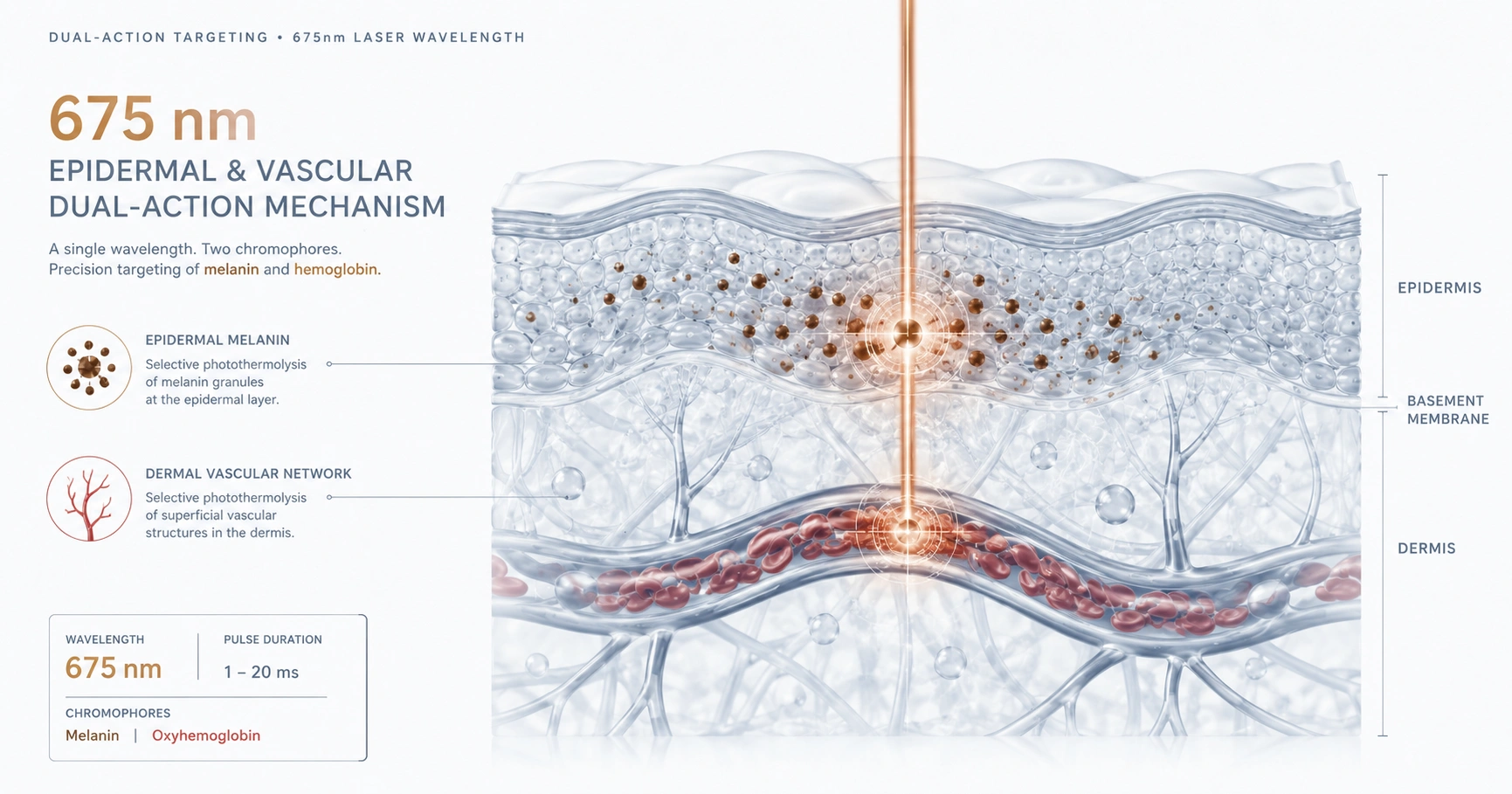
Clinical evidence confirms that the non-ablative 675-nm wavelength addresses facial melasma by concurrently targeting epidermal hyperpigmentation and the underlying dermal vascular network. By inducing localized thermal columns that stimulate type IV collagen contraction in the capillary basement membrane, this protocol mechanically constricts the vessel lumen to down-regulate regional hypervascularity. Operating under low-fluence parameters, this sub-ablative approach minimizes post-procedure tissue inflammation, delivering measurable skin uniformity across Fitzpatrick phototypes II and III without risk of rebound hyperpigmentation.
Technical Review and Mechanics
How does the 675 nm wavelength target both epidermal melanin and the capillary basal membrane simultaneously?
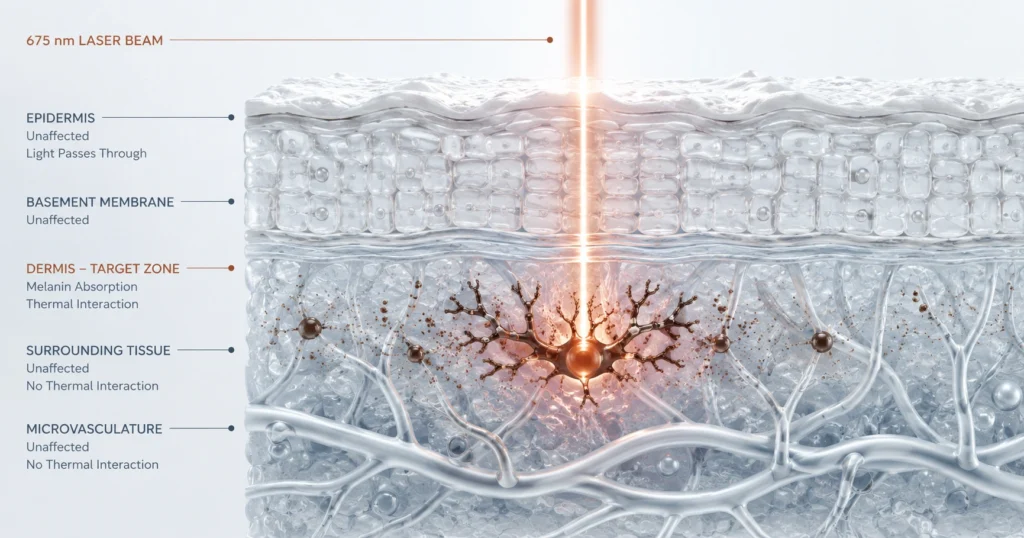
The 675 nm laser for vascular component melasma utilizes high selective absorption to target melanin chromophores and the capillary wall structural matrix concurrently. This red-spectrum wavelength delivers focused thermal columns directly to the dermal-epidermal junction. Using a fractional configuration, it generates sub ablative fractional laser micro zones hyperpigmentation target-locked at a width of 0.7 mm, ensuring precise energy delivery while leaving surrounding healthy tissue unaffected.
What is the physiological relationship between type IV collagen shrinkage in facial blood vessels and melasma stabilization?
Capillary wall modulation for refractory mixed melasma relies on energy absorption by structural proteins within dermal vasculature. Facial capillaries consist of an endothelial monolayer and a basal membrane composed of type IV collagen. The 675-nm wavelength targets this layer, inducing localized type IV collagen shrinkage in capillary basal membrane zones. This contraction mechanically constricts the vessel lumen, reducing blood flux and down-regulating vascular erythema. Furthermore, modifying this matrix activates anti-angiogenic properties, inhibiting endothelial cell proliferation to stabilize the tissue microenvironment.
Why does a sub-ablative fractional laser protocol reduce the risk of rebound hyperpigmentation compared to traditional intense pulsed light?
This system utilizes low fluence laser parameters preventing post inflammatory hyperpigmentation by keeping tissue inflammation minimal. While traditional intense pulsed light options prompt inflammatory cascades that stimulate melanocytes, this fractional protocol operates at lower energy settings. How does modifying the extracellular matrix with a 675nm laser down-regulate vascular endothelial growth factor and stem cell factor? By limiting thermal diffusion, it avoids activating cellular pathways and stem cell factors (SCF) that induce secondary melanogenesis, ensuring safe parameters across Fitzpatrick phototypes II and III.
What are the documented Global Aesthetic Improvement Scale scores for pigmentary and vascular clearing using the RedTouch laser system?
Data from a VISIA imaging system tracking pigmentary clearance scores demonstrated a 0% non-responder rate at a 3-month post-treatment follow-up. Objective evaluation via the 5-point Global Aesthetic Improvement Scale (GAIS) yielded a mean score of $2.28 \pm 0.67$ for the pigmentary brown filter and $2.17 \pm 0.79$ for the vascular red filter, confirming moderate-to-good clearance. The global appearance score was $1.89 \pm 0.96$. Subjective pain metrics showed a mean Visual Analog Scale (VAS) score of $1.89 \pm 0.83$, confirming high tolerability. Transient erythema resolved within hours, requiring no clinical downtime.
References
Coricciati, L., Gabellone, M., Donne, P. D., Pennati, B. M., & Zingoni, T. (2023). The 675‐nm wavelength for treating facial melasma. Skin Research and Technology, 29(8), e13434. https://doi.org/10.1111/srt.13434