Architectural Restructuring: Addressing Facial Photoaging and Diffuse Pigmentation via Focused Wavelength Therapy
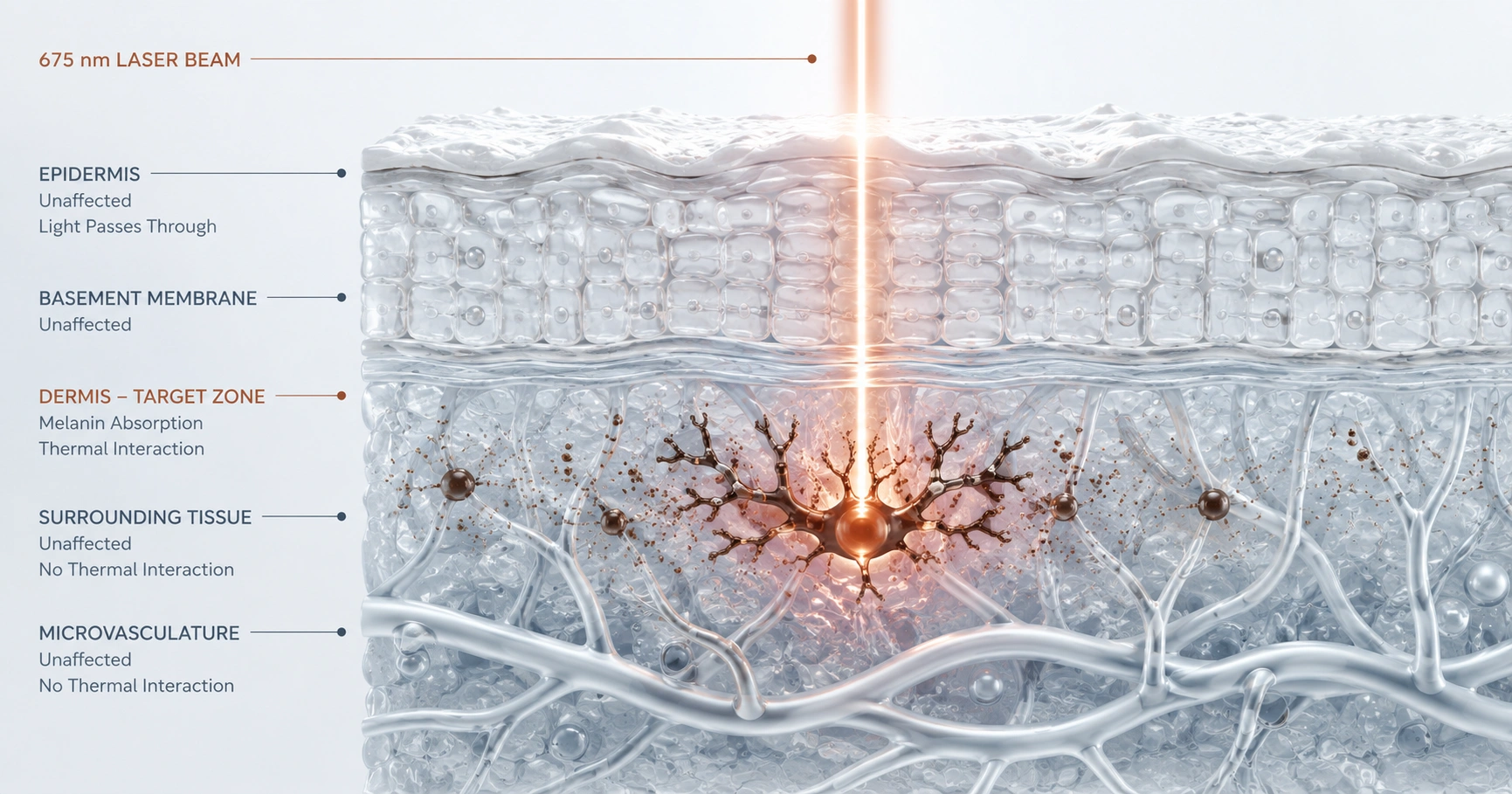
The high-power 675 nm laser system utilizes a selective photothermolysis mechanism to address facial photoaging and diffuse pigmentation by directly targeting melanin and initiating Type III collagen synthesis. Operating at an upgraded 15 W configuration, the system compresses treatment duration by 50% while protecting the epidermis via an integrated 5°C contact cooling window. Standardized clinical data verify significant structural tissue improvements with minimal patient discomfort, providing objective dermal restructuring without prolonged recovery periods.
The 675 nm Laser Dermal Remodeling Mechanism
How does the 675 nm wavelength achieve high selectivity for melanin while ignoring water absorption?
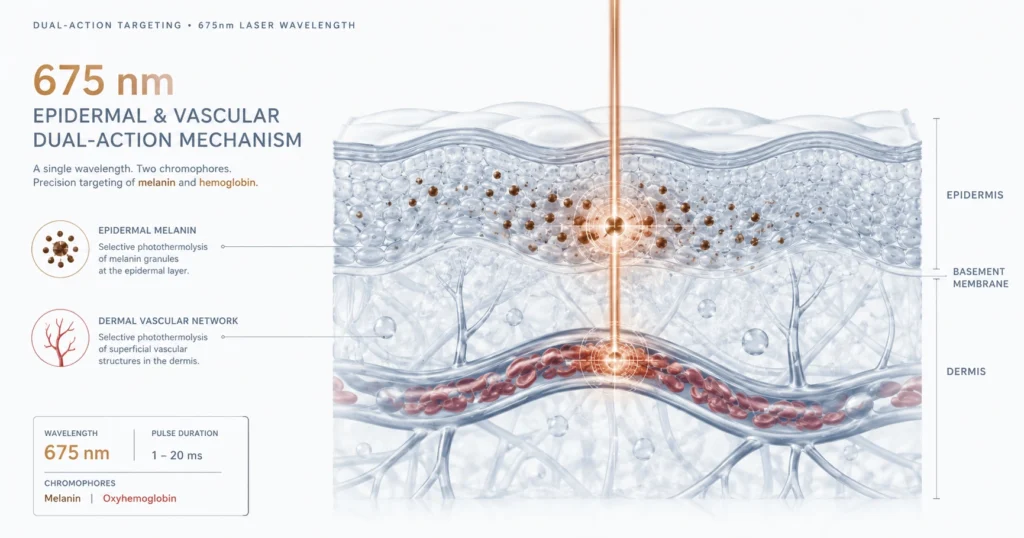
The 675 nm wavelength operates within a light spectrum demonstrating high specific affinity for the melanin chromophore, with low absorption by water and vascular structures. This optical isolation enables precise deployment as a non ablative laser for décolletage solar lentigo, delivering targeted thermal energy to pigmented anomalies while completely sparing surrounding normal tissues.
How does the 675nm laser influence Type I and Type III collagen in dermal fibroblasts?
The 675 nm laser induces selective thermal denaturation of existing collagen fibers, stimulating dermal fibroblasts to accelerate the deposition of Type III collagen fibers. Quantitative in vitro fluorescence testing confirms that exposure decreases Type I collagen while significantly increasing Type III collagen, with zero negative impact on cell proliferation or viability. This biological pathway drives effective Type III collagen synthesis laser rejuvenation by structurally reorganizing the extracellular matrix.
Capillary Basal Membrane Collagen Type IV Laser Contraction
Vascular improvement occurs as the 675 nm wavelength targets the collagenous components located inside the capillary basal membrane. Laser absorption prompts vessel lumen contraction, reducing capillary diameter and localized blood flow. Clinical stimulation of structural collagen types IV and XVIII introduces antiangiogenic characteristics that restrict endothelial cell migration and proliferation, reducing diffuse background redness.
System Parameters and Operational Modalities
Why does the high power 15W configuration reduce treatment times by fifty percent?
The high-power 15 W configuration delivers energy fluences rapidly, allowing the continuous scanning modality to shorten the active Red Touch PRO Moveo mode treatment duration by half compared to standard configurations.
- Wavelength / Spot Size: 675 nm / Approximately 0.7 mm micro-areas of denaturation (DOTs).
- Scanning Modality: Moveo mode executes a single, continuous line up to 13 mm long, avoiding overlapping pulses. Standard mode requires stationary scanning of a $13\times13\text{ mm}$ area.
- Epidermal Protection: An epidermal protection 5°C sapphire cooling window insulates superficial layers from thermal migration.
- Throughput: Active treatment requires only 3 to 6 minutes per targeted zone.
Quantifiable Clinical Metrics and Recovery Expectations
What are the quantitative clinical outcomes of Red Touch PRO Moveo mode for facial fine lines?
Clinical case series verify a 675nm laser facial photoaging GAIS score of 3.40 ± 0.55 for facial rejuvenation, demonstrating structural reduction of periocular and perioral lines. For diffuse décolletage pigmentation, the measured mean GAIS score reached 3.00 ± 1.00, achieving an objective satisfaction rating of 3.67 ± 0.58.
What is the expected trajectory for paradoxical darkening and micro crusting after a 675 nm laser session?
Patients experience transient diffuse erythema and expected temporary darkening of targeted melanin lesions, followed by mild micro-crusting that resolves completely within 7 to 10 days. Discomfort levels on Visual Analogue Scale for 675nm laser remain low, yielding mean scores below 0.40 out of 10 points. Longitudinal follow-up at 6 months confirms long-term tissue stability and sustained neocollagenesis.
References
Vitale MDE, Madeddu F, Fusco I, Bonan P, Gallo G, Zingoni T, Piccolo D. Clinical evidence of high-power 675 nm laser system equipped with a faster treatment modality for the management of pigmented lesions and skin rejuvenation. JAAD Case Rep. 2025;58:93-98.